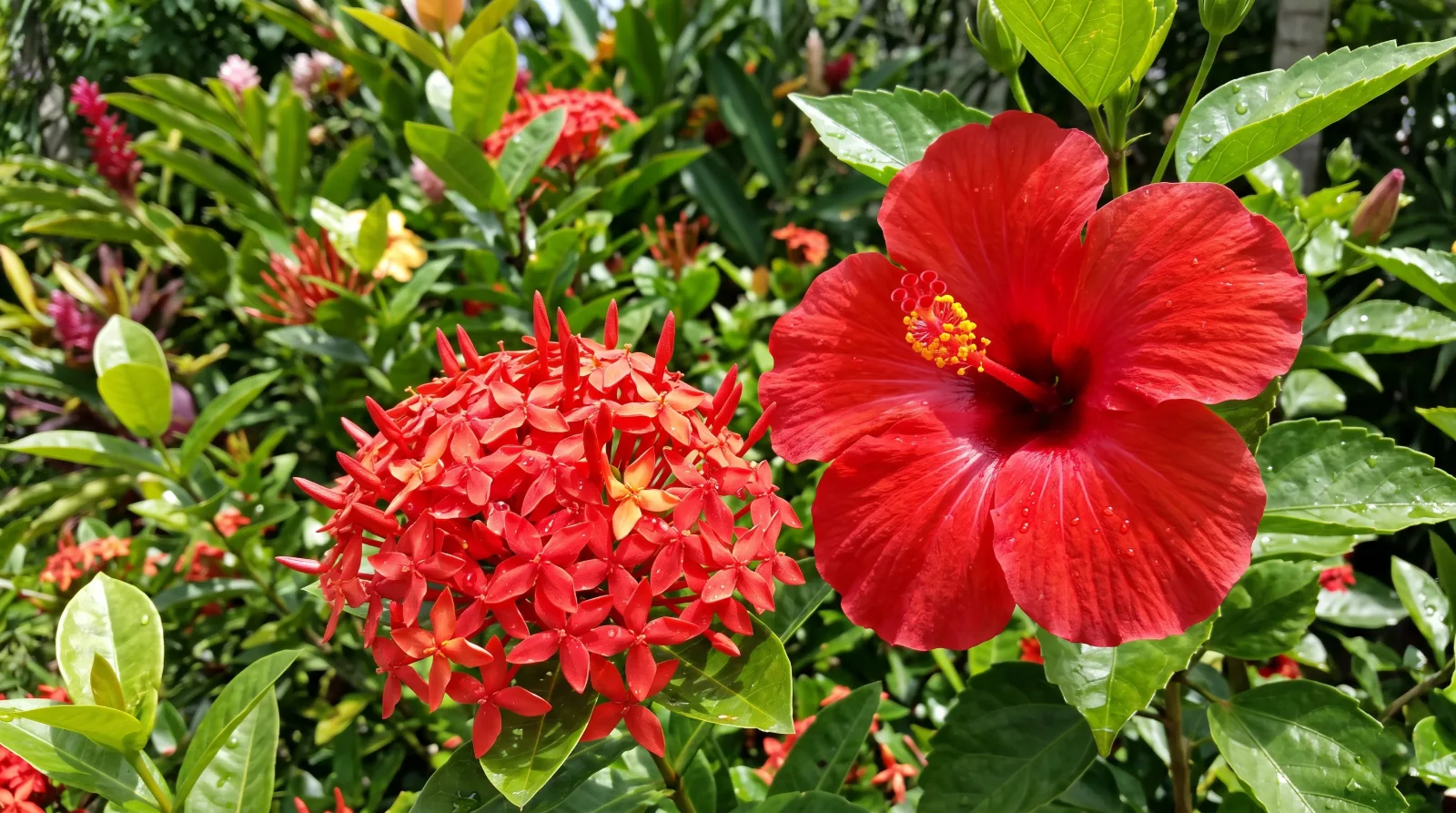
When a hospitality or resort brief asks for lush, saturated, unmistakably tropical colour, two genera do most of the heavy lifting: Ixora and Hibiscus. Both flower hard in Gulf heat, both come in a spread of colours that let you compose rather than just fill, and both reward correct siting with months of bloom. They are also easy to get wrong. Here is how we specify them.
Ixora and Hibiscus deliver the saturated tropical colour resort and hospitality briefs ask for, but both need shelter from the harshest afternoon sun, consistent water quality and a real maintenance regime to survive a Gulf summer.
- Ixora clips tightly and holds colour in mass planting; Hibiscus is the signature specimen flower.
- Both need afternoon shade, good drainage and salinity-controlled irrigation to hold through summer.
- Budget the maintenance regime up front — these are not low-input plants.
Ixora — colour you can clip
Ixora is the more disciplined of the two: a dense, glossy-leaved evergreen that carries tight, rounded clusters of small flowers and takes a clip beautifully. That combination — flower plus form — makes it one of the most useful flowering shrubs for structured tropical planting.
Our range splits into two species. Ixora chinensis (pink, red, white and yellow) is the taller, looser grower for informal massing and low informal hedges. Ixora coccinea (pink, orange, red and yellow) is more compact and the better choice for tight, repeated low planting and container work. Specify by species and colour, because the habit difference changes both spacing and maintenance.
Hibiscus — the signature flower
Where Ixora gives you mass, Hibiscus rosa-sinensis gives you the single, show-stopping bloom — the flower most people picture when they think "tropical". It works as a specimen, an informal flowering hedge or a screen, flowering almost year-round in our climate. Hibiscus schizopetalus, the fringed or "spider" hibiscus, is a looser, pendulous form that earns feature positions and looks superb spilling over a raised edge or pergola.
The trade-off is appetite: Hibiscus wants more water and feeding than the desert-tough shrubs, and it shows stress quickly. Place it where it can be irrigated and seen — entrances, courtyards, pool surrounds — not on a forgotten perimeter.
Getting them through summer
- Light — both flower best in full to near-full sun; in deep shade they turn leafy and shy.
- Drainage — neither tolerates waterlogging; on heavy or reclaimed ground, amend and raise beds so roots can breathe.
- Salinity — these are tropicals, not natives; on high-salinity TSE irrigation they need good drainage and a leaching regime, or leaf-margin scorch follows.
- Pruning — Ixora takes formal clipping; Hibiscus prefers a lighter, selective prune that keeps flowering wood.
Specification and supply
For resort and hospitality work the usual ask is uniform, well-furnished plants that look established on opening day. We supply Ixora in container sizes suited to both low hedging runs and feature massing, and Hibiscus from bushy shrub grades up to larger specimens. For a clean, repeated hedge or border, reserve a single batch so colour, height and density match across the run — mixed batches are the most common cause of a patchy finish.
Ixora and Hibiscus deliver the tropical look a resort sells — but they are guests in this climate, not natives. Give them sun, drainage and a place worth irrigating, and they perform.
Used where they belong — the irrigated, high-visibility heart of a scheme — Ixora and Hibiscus give hospitality landscapes the saturated, brochure-ready colour that briefs demand. Used as cheap perimeter fill, they disappoint. The species and colour you choose, and the spot you put them in, decide which outcome you get.
Looking to source these plants?
Request a wholesale quote and our team gets back to you fast.
Request a Quote →